The last place…

It’s true that not only is the last place you look the place that will uncover the lost item or reveal the information, but it’s often really the last possible place to look.  It’s also a truism that the shoemaker’s children are often the last to have shoes made.

Last week, finally, I had the last few of the cache of letters I have had lying around translated.  The 6 letters that had not been translated were in Yiddish and a combination of Yiddish and German.  The first 4 letters in Yiddish, from my great-grandparents in Romania, were mostly letters complaining of ill health, loneliness since most of their children had left for America years earlier, and neglect by those children as evidenced by sufficient money not being sent home to keep the parents comfortable.

The last two letters were the German one and a Yiddish letter.  What made these different was that they were written after the death of my great-grandfather.  The Yiddish letter, written shortly after his 1926 death, was from my great-grandmother, with some of the same earlier complaints, but now, added to this was concern (and complaints) about waiting for a ticket to join her children in America.

The German letter, a year later, was from Montreal, and identified the writer as one of my great-grandmother’s sisters.  A sister I didn’t know she had.  In this letter, the sister was adding her voice to the anguish my great-grandmother had expressed and asking why, after so long, was she still in Europe!

These letters answered a question of why it took 2 years after the death of her husband for my great-grandmother to leave Europe for the US.  It also answered the question of who the person in Montreal was.  Thirty years ago, my grandfather asked me to find out what happened to the writer of that letter, who he identified only as someone who was important to his mother.  It turned out that the woman in Montreal died less than a year after her sister arrived in the US – I don’t think they ever saw each other.  The sister in Montreal had left Europe 25 years earlier.
Posted in Uncategorized | Leave a comment

Hurray! Ellis Island resources are accessible on site!

Many, many thanks to Jan Meisels Allen, Chairperson, IAJGS Public Records Access Monitoring Committee, for so articulately summarizing what is happening at Ellis Island.  She wrote:

“…the new Ellis Island National Immigration Museum story goes to the present day whereas the Ellis Island Immigration Museum story covered only through 1954. The new gallery, Peopling of America, opens today, May 20th. This major expansion of the museum “bookends” the Ellis Island era by telling the story of immigration to America before the processing station opened in 1892 and after it closed in 1954. To read more see: http://tinyurl.com/kpwuaxp Original url: http://www.libertyellisfoundation.org/peopling-of-america-center?ccd=email.CAMP30029 The historic baggage room now houses the world migration globe depicting migration patterns around the world, not just to the United States. There are displays about pre-Ellis Island as well as post-Ellis immigration. Displayed at the entrance is the American Flag of Faces, an interactive video with a montage of images submitted by individuals about their families and ancestors. If you would like to submit photos see: http://www.libertyellisfoundation.org/about-the-flag-of-faces The site also has a link about genealogy-see: http://www.libertyellisfoundation.org/genealogy

Posted in Uncategorized | Leave a comment

But it Sounds Like…

As a genealogist I often work with transcriptions of documents not originally written in English.  Of course I also work with documents written in English.  A lot of the time, even if the document is one which a person filled out themselves, spelling of names and places seems a bit “off”.  We can clearly see documents written in English in the late 19th and early 20th centuries and earlier, where significant changes in the spelling of a name makes it difficult to track a person, and we have to rely on other information like occupation, children’s or spouse’s names, birthplace, address, and other date.

Think of how this gets compounded when the person doesn’t read or write English, or in a very heavy accent is pronouncing a name or place and another person is writing what s/he hears.  A fairly common name like Schwartz (German for “black”) can be written in many ways.  Some of these might be SZWARC, SHVARTS, SZWARTZ, SZWARZ, SWERCZ, SWIERCZ, SWIRCZ.  Now imagine looking at the original documents written in Polish or Hungarian (both of which use the Latin alphabet but have more letters than English), or at Cyrillic (the alphabet used to write Russian, Ukrainian, Bulgarian, Serbian and other languages)  or Yiddish documents (written in using the Hebrew alphabet), neither of which use Latin letters, and trying to determine which of the names could sound like “Schwartz.”

So, what’s a person to do?  Try not to be completely wed to the way the names you are looking for should appear.  Keep your mind open, after all, what if the name really began as Schwatzkopf, Schwartzbrodt or Schwartzberg?  Google the alphabet for the language you are looking at so that you can understand what letter combinations make which sounds – this will be a great aid to picking out names – you can try some combinations of the letters before hand so that you have an idea of how the name should look!

Posted in Uncategorized | Leave a comment

Two Marriage Records – Same Bride, Same Groom?

Okay, what gives with this?  Why would there be duplicate marriage records a few days, weeks or months apart for the same bride and groom?  Really, they are the same couple – no mistaking this – their parents’ names are the same, ages, occupations, birth places and addresses all match on BOTH certificates.  The certificates of course all have different numbers.  Today I spent time looking at the marriage certificates/records of 5 different couples in the New York City Municipal archives. Their marriages were recorded between 1903 and 1937, the last year that marriage records are publicly available in New York City.

The answer proved to be very simple.   Perhaps this is not always the reason for these duplicate certificates and records, but it was clearly the same reason for these 5 couples.  In each case, one certificate represented a civil marriage, often but not always, conducted in a municipal office.  The second certificate represented a religious marriage and was conducted by a Rabbi or Cantor – a person designated by one of those titles or by the title “Reverend” which is a generic, non-specific title designating clergymen (in those days it was all men).

I don’t know if this situation exists today outside the United States, or if we are even still likely to find this occurring today.  These are examples of the separation of civil and religious ceremonies both designed to unite a couple in what we refer to as “marriage” – a category which does not distinguish between the civil and religious union.

In Eastern Europe, when there were religious marriages in the Jewish community, those marriages were not always recorded with the civil authority, and outside religious boundaries, that couple was not considered to be married, and the children of that union were generally given the mother’s surname, not the father’s. If and when that marriage was registered (often years after the birth of their children) the record was frequently amended and a note was inserted about the paternity, often with a surname added to the one given at birth.

So a person’s name might be Name X v Name Y where “v” coming from the Latin word vel, which means “also known as.” This person might then be known by both names, where the person might sometimes be known by the mother’s name and, at other times, by the father’s name.  Or Name X r Name Y where “r” coming from the word recte means “legally” and would mean that this surname was the ‘legal’ name.  There is a 3rd way a name might appear and that is with an “f” between the names standing for “false” which might mean that the person was not legally supposed to be using that surname which was the father’s surname and the parents’ did not have a civilly recorded marriage.

Posted in Uncategorized | Leave a comment

Everytime new information is revealed…

…it leads to more questions.  Some of those questions are waiting to be answered through discoveries of resources in archives, some will remain, regretfully, unanswered.

At one time I had a stack of letters in many different languages – Polish, German, Yiddish, Russian – none of which I could translate.  I still have that stack of letters, but they are now, almost all translated.  These last few are from my great-grandparents in Romania in the 1920’s, all are handwritten.  Four letters are in Yiddish, two are in German, with Yiddish (in Hebrew letters) scattered throughout.  Three Yiddish letters have, to date, been translated.

I have records of my family in Romania dating back to the 1870’s and all of the records, no matter what their origin (local, regional, union, personal) all have the surname spelled exactly the same way, in Latin letters, in German and Romanian.  The handwritten letters are different.

The Yiddish letters are all written by (or for) my great-grandfather to his children in the United States.  None of these are written by my great-grandmother.  The German letters, written a few months after my great-grandfather’s death are written by my great-grandmother.

The Yiddish letters include messages from my great-grandmother or are clearly being written on behalf of both of them, and are signed with a first and last name, not “your father” or something similar.  Although my great-grandfather’s name, in Yiddish is spelled exactly the way we would think to find it, his surname is spelled differently than we would expect, based on ALL the Romanian and German records.  The questions arising from this are:

  1. Did he write the letters or did someone else write them for him?
  2. Why are they signed with his full name?
  3. Why is the name spelled the way it is in Yiddish?

Then there are other questions based on the content of the letters in which the complaint is of constant ill health (my great-grandfather was in his mid-70’s at this point), and poverty. The questions:

  1. Why didn’t they come to the US – all their children were grown and all except one were in the US – my great-grandmother left Romania for the US by 1928, after her husband’s 1926 death.
  2. The letters speak of acrimony and neglect by their children and allude to disagreements – what was going on within the family?
  3. The letters mention a lack of communication with some of their children and even not having current addresses – what was going on.

Questions layered upon questions.  No answers in sight.  Maybe this last Yiddish letter or the 2 German ones, still to be translated will provide some answers.

Posted in Uncategorized | Leave a comment

Round and Round We Go!

I have identified 5 unique family groups and 1 additional person all living in Tuckums, Courland with the same surname in 1871. I have no idea if these are related to each other.  I have tracked two of those families to Michigan, US.  Well, let me rephrase that – I tracked two of these families from Michigan back to Courland.  Why you might ask did I do that, especially since I just commented that I could not tell if they were related to each other.

Well, therein lies the tale.  These two families settled in a  part of Michigan which was not, at the end of the 19th century, densely populated, nor is it now.  Three men, sons of Israel and Hanna settled in one small town, and three men, sons of Chaim Solomon and Chasse settled in another small town not too far distant.  There were no other people in the area with the same surname.  Through time and generations both families spread out.  Today they live in CA, MA, NY, FL, and all over Michigan, just to name a few places.

Thanks to probate documents I have now identified and verified all of Chaim Solomon and Chasse’s children, some of whom remained in Europe, some of whom came to the US in the years after their brothers did.  I have found no such papers for Israel and Hanna’s sons, but I admit, have not YET looked for them.  This is something which will be remedied over the next couple of weeks (of course).

I have found that Chaim Solomon’s father’s name was Marcus and Marcus’ father’s name has been transcribed as Heyman.  I haven’t seen the original but it’s probably Chaim.  Heyman/Heiman are an Anglicized (but maybe Gemanicized name, too?) version of Chaim.  So what do I have?

I have still not discovered a common ancestor.  I know there has to be one.  I have two brothers who both name their sons Heiman but who I have to yet connected to Marcus’ father.  Could Marcus, whose son Chaim was born in 1828, have been a brother to Israel and Judel?  Israel’s son Heiman (based on Israel’s grandson’s age) was born around 1810, and Judel’s son Heiman was born around 1828.

One of Israel and Hanna’s sons, Sam, moved to go into business with one of Chaim and Chasse’s sons.  Sam also moved to Detroit at about the same time as his business partner did, although it does not appear that they remained in business together in Detroit.

I know that feelings do not create documentation and proof.  I am definitely not at a point where I can say that the evidence is incontrovertible and that I have met a proof standard (only a guess standard and perhaps not even that).  Searching through records, and attempting to draw those lines of proof closer together until I either prove or disprove my hypothesis that these two families are related.


Posted in Uncategorized | Leave a comment

Handwriting (please!)

Handwriting (please!)

Filed under: Uncategorized — Janette Silverman @ 9:25 pm Edit This

Some days, today, for instance, I wish I could do the absolutely impossible.  I wish I could shake people who were in charge of creating records and say in very firm tones: “watch the way you are writing.  Someone in the future may need to read this.”  Of course it can’t be done, and the records we have are, well, the records we have.  I am attempting to figure out what brought a family from Arenac County, Michigan to Detroit.  In fact, more than that,  am trying to figure out who it was that they exchanged visits with in Detroit for several years before relocating there in the very early 20th century.

I know that the immigrants in the family I’m tracing came from Europe in the years between 1875 & 1885.  Other members of their extended family came around the same time, and all of these settled in areas where they could supply goods to the lumber and fur trades.  Ultimately my target family opened up dry goods stores.  They married, raised families, and then, in what appears to me to be sudden moves, they were visiting with people back in Detroit and ultimately moved to Detroit between 1914 and 1920.

Today, looking for some clarity, I went looking for everyone in Detroit with the same surname in 1910.  Of the 5 families with that surname in Detroit in 1910, I eliminated 2 families that appear to be of a different ethnic background than my target.  That left 3.  I started looking to see if I could find immigration records for a person in one of these families who apparently came over as an 8 year old in 1871.  It looked like I found only one family that would be a candidate –  a woman and her 2 children with that surname on a ship in 1871 – one of the children had the same first name as one of  the people on the 1910 census.  The only problem was that he birth year would make her 10 years older than her son according to the transcription.  No, the transcriptionist wasn’t at fault in this case – that’s actually what it looks like the person who wrote the information on the manifest wrote.  Of course the handwriting is really less than clear.

Like I said, I’d like to go back in time and give very clear instructions to the people filling out these forms.

Posted in piecing the puzzle together | Leave a comment

So, what’s in a name?

Shakespeare said it long ago – a rose by any other name would smell as sweet.  However, in order to connect the word with the object, we need a clear path.

In my mother’s family, my great-great grandfather seemingly arbitrarily used a variety of names – first and last.  His children seem to have each selected one of the surnames he used and that branch of the family went with that name.  His son, my great-grandfather, thankfully, listed all the names, first and last, by which his father used, on his father’s probate record.  Thank you, Allan Jordan for pulling those records for me several years ago.

Having that list of names gave us the ability to figure out relationships with people we thought were family, not just family friends.

My father’s family is more straightforward.  Surnames in his family basically stayed the same from Europe to the U.S. with little variation.  First names, however, were an issue.  There was one person to whom we kept referring to by what we thought was his name  – it was what his mother in Europe called him in her letters.  Decades later, we found out what his name was and that she had been referring to him by an endearment – always the same one!

One day, I got a phone call from a woman I had never heard of.  She had been looking at my tree, and called me, very excited.  Almost her first words were: “Your Mali is my Amalia.”  Once I understood what she was talking about, I pulled up my tree and hers to compare and was able to say to her “Your Chiel is my Yechezkiel, and your Israel is my Srul.”  Very exciting finds, and a wonderful familial connection.

But what of the Anshel, Leibe, Yudel, Salka, Shaiku and Mundek.  Who were these people?  Were they or their descendants still alive?  One afternoon, sitting with relatives and trying to piece this together, someone commented that she had a vague memory of someone calling her grandfather “Louis” by another name – Leibe!  That started a furious conversation that lasted for hours and followed many paths.  We pulled out photos of gravestones of people we thought were related but hadn’t identified, and photos of people with Yiddish names scrawled on the back.  It took a while, but ultimately we found that in our family Anshel = Arthur, Yudel = Julius, Salka = Sarah, Shaiku = Asher and Mundek = Moses.

So, what’s in a name?

Posted in piecing the puzzle together, research tips | Leave a comment

Turn it and turn it again…

Without sounding too irreverent, there is a Talmudic statement found in Pirke Avot (Ethics of the Fathers) 5:22 – Ben Bag Bag used to say, “Turn it, and turn it, for everything is in it. ”  Ben Bag Bag was referring to the Torah, and I am definitely not referring to the Torah, but rather to the “facts” or the things we take to be clues when we are doing genealogical research.

Although we need to remain skeptical when reviewing non-documented facts and not trust in anything at all – a name, date or place, until we find documentation, that high degree of skepticism really can serve us well – it causes us to peruse the documents and files, and to expand our range of where and how we look.  Sometimes the best we can say is that there is a better than even chance that the material we are examining is the correct documentation.  Having accepted that, this new “fact” helps to inform the direction in which we are looking, and may ultimately be proven to be “true.”

It may also prove to be false.  Remain skeptical.  Look carefully.  Examine alternatives and options.  Did the person for whom you are searching use other names?  Can you find her in a group of people whose names may fit other people you’ve identified?  When Amelia could be Malka or Mali, and Becky is Rivke, Martha is Masha, Julius is Yudel and …. well, you get the picture.  Imagination may be your most important tool.

After hours of looking for them on US censuses, and then naturalization records I found the censuses but not their naturalization although the claim according to the 1920 census was that that had been naturalized.  Of course the census also stated that several members of this family had been born in the US, who, it was clear from when the adults claimed immigration, could not have been.

The matzevah (gravestone) yielded a Hebrew name for Amelia, so armed with that I went to ship manifests to see what I could see.  Based on what I “knew” – her approximate year of birth and immigration year I found nothing.  By expanding my search and looking for the first name and a “sounds like” choice of the last name, I found a garbled transcription which had some possibilities.  When I looked at the arrival manifest, I realized why the transcription was garbled – the manifest was very difficult to read. Then, I looked for corroboration that I was reading the manifest correctly, and found a departure manifest which had the names more clearly written – a mom and 4 children. But wait – my records  indicated that she should have only been traveling with 3 children.  Where did the 4th come from?

Back to the records I had found – all secondary sources (no birth, death or marriage records) and a careful reading of often smudged documents led me to a census which asked how many children the mom had given birth to and how many were still living.   The census form indicated that there was one more child than I had accounted for, who, based on the ages of the other children at that time, had not survived early childhood.  Later on, finding a birth record for one of the children born not too many years after the family’s arrival in the US, indicated how many children had previously been born to these parents, the primary source corroborating the secondary source.

The date of the manifests pointed me to the possibilities of when the dad arrived in the US, and armed with this, I was able to find a like, not definitive, but likely manifest.

So, turn it and turn it again – look at the data from all angles and then look some more.

Posted in piecing the puzzle together, research tips | Leave a comment

When does it end?

As a genealogist, I can’t answer that question definitively.  For some of us, the research never ends – it may come to a temporary halt when we are confronted by what appears to be an insurmountable brick wall, while we regroup; or, we may decide that at least for the near future, we have attained the goals for the research we are doing.  Then what?  Well, in my case, a culmination of several years of research for one branch of a family led to a trip to meet the descendants, and celebrate.

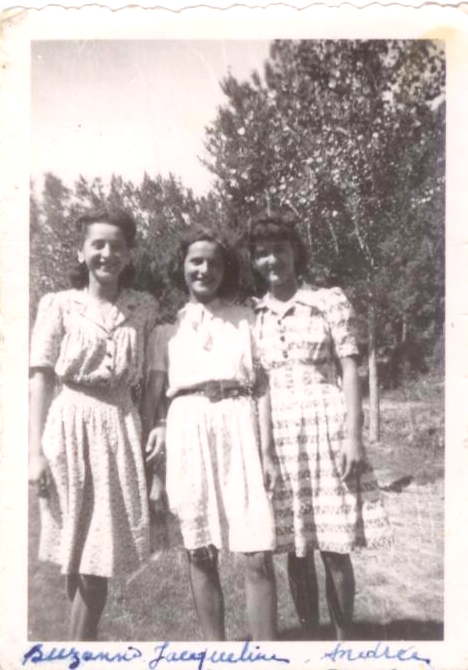
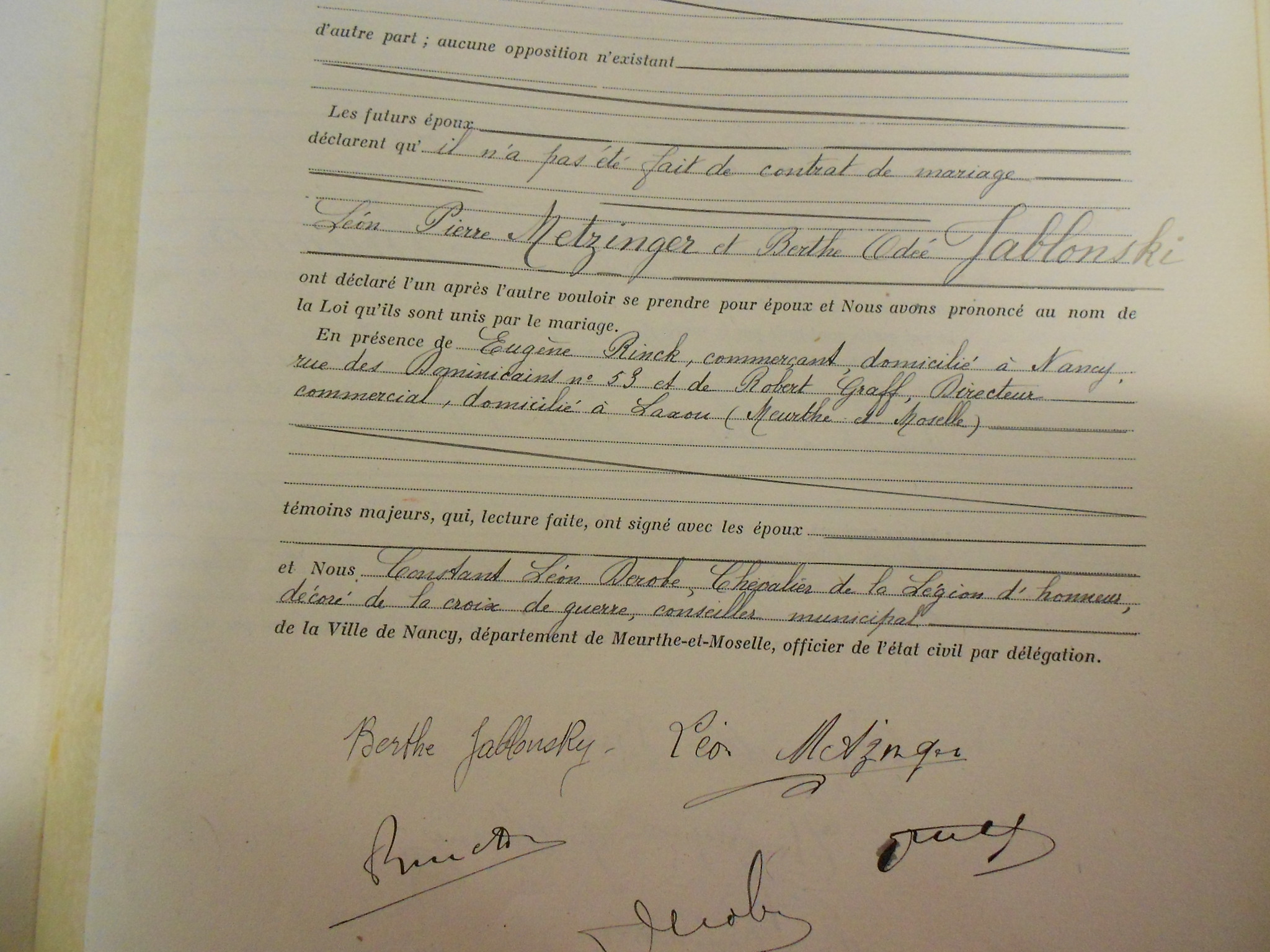
Ok, you may be saying, anything for a celebration.Jablonski-Metzinger marriageSuzanne, Jacqueline and Andrea front 1944

Well, sure.  I’m up for celebrating the small as well as   the large accomplishments.  But, in this case it was a major accomplishment.  You may have heard me speak (or read what I;ve written) about the difficulties of beginning research with two photos of people identified by first names only and no concrete data beyond that.  In this case, as in so many others, networking and crowd sourcing to develop research partners, as well as patience and time led to a happy conclusion to that particular branch of research.  So celebrate we did.

This is one of the records we found that ultimately led to the identification of a family in Nancy, France, and their descendants, and the culmination of that research by visiting them to celebrate in person.

Posted in Uncategorized | Leave a comment