Michigan Trails

Last week I had an incredible day of research productivity in a part of Michigan I had never visited – genealogical research takes you on the most amazing adventures.  I was heading to West Branch, the upper lower peninsula (in case you know Michigan geography, which I can’t truly say I do).  In West Branch I was scheduled to speak on the Blumenthal family who had established the first dry goods stores in Ogemaw County (in which West Branch is located) and Arenac County.

As in most genealogical quests, I had some unanswered questions and decided to stop in Bay City, on the way to West Branch to check out a tombstone or two.  It was raining and the cemetery gates were locked.  Being the intrepid sort of researcher I am, I shielded my camera and hoped for a readable photo of the distant stone, which I could see from the road (lucky me, right?).

In West Branch, after a few tech glitches, I laid out the research I had done on the branch of the family that had left West Branch and gone to Standish.  The audience included a descendant of the West Branch branch and a descendant of the Standish branch – they had never met before and until just a few weeks earlier, had not heard of each other.

As I was giving my talk, I had a brilliant inspiration – since I was in a part of the state to which I was unlikely to return, why not stop at a library in Arenac County and see what local information could be found about the family in Standish.  Finding the library was easy, but the local history section only contained recent local history and I needed to go back over 100 years.  The very helpful librarian located a county historical society in Au Gres and off we went to find the volunteer staffing it that day.

I just love people who are passionate about the work they do.   The volunteer at the Arenac Historical Society, surrounded by mostly un-indexed and un-digitized original documents worked closely with me to locate a few precious references and promised to hunt down other documents and newspaper articles for me.

She very kindly xeroxed the documents she was able to find easily, and we purchased a booklet about the history of the area that included some references to 2 of the people I was trying to track.  After carefully reading the history and looking at some of the material I realized there was a discrepancy in the date of death – it was hand written on an obituary as 1951 and written in the history as 1949.

After a couple of hours on-line I found a death certificate and a copy of the guy’s gravestone – both of which agreed with the handwritten note.  Quite a few mysteries remain – right now it looks as if I have 2 branches of a larger family – each branch had 3 brothers.  One branch originally settled in West Branch around 1885, the other in Standish around the same year.  One of the West Branch brothers, Sam,  went to Standish between 1894-1895 and went into business with one of his cousins, Harry, who was already there.  Harry may have originally come to Standish to join an older brother, Marcus, who was already established.

Marcus left Standish before 1915 and went to Traverse City, then to Iowa and finally to California.  Sam left Standish between 1910-1920 and went to Detroit.  Harry remained in Standish.  Sam’s 2 brothers stayed in West Branch.  Harry and Marcus had another brother who may have gone to Massachusetts.  Obviously, I’m still searching for the rest of the story.
Posted in Uncategorized | Leave a comment

WWI Fallen Memorialized

I think the new British site, Every Many Remembered is amazing.  It is of course, not only for “men” and is a combination of two sites – Every Man Remembered and Every Woman Remembered.  Go to http://www.everymanremembered.org/ and remember the fallen.

The site is a collaborative effort between the Royal British Legion and the Commonwealth War Graves Commission. They are inviting people to commemorate the fallen by finding a relative in the database of 1,117,077 men and women who died during the First World War, or by finding someone that no one has yet claimed, and writing a tribute. 

I am a firm believer of connecting to people from the past by somehow remembering their names, especially when the person may very well have no living relatives.


Posted in Uncategorized | Leave a comment

Documents as proof

We know that the best source for proving the occurrence of an event is contemporaneous documentation – death, birth, marriage certificates just to name a few. 

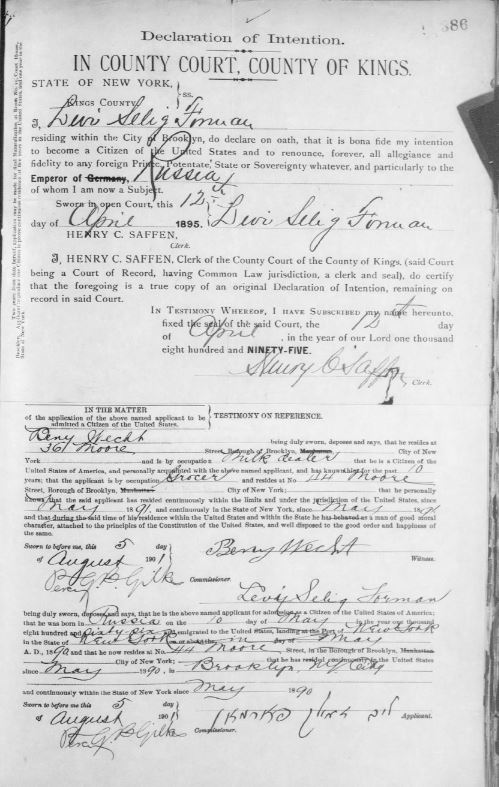
Those documents and others do more than just provide supporting evidence for the event.  They provide a connection to the past.  Often the documents are signed – not just by the official whose job it was to do that, but by a relative for whom we’ve been searching.  That signature connects us to the document, not only to the event.  Take the Declaration of Intent for Levi S. Forman, signed in 1895, in Yiddish!  My vivid imagination now creates a mental image of my great-great grandfather with the red hair (how my grandmother used to refer to her grandfather) signing this important first step in attaining citizenship.

Forman, Levi S declaration 1895

Posted in Uncategorized | Leave a comment

Networking as a viable research tool

As the Beatles sang “I get by with a little help from my friends.”  What would any of us do without our friends and colleagues?  In genealogical research networking is one of the most important tools to use.  There are so many databases and resources worldwide, it’s impossible for any of us to know about all of them.

Consulting with fellow researchers, sharing brick walls, names and places can have remarkable results and often end up with discovering or uncovering amazing documents.  Just this week, thanks to my ever-growing network, I found 19th century death records for my great-great grandparents, and have records galore to explore in search of other “missing” relatives. 

Colleagues spread out around the world may have access to archives that are impossible for me to get to easily and are often willing to check resources as I am for them.  It’s remarkable what can be uncovered when more than one person is involved in a search.

Posted in Uncategorized | Leave a comment

…it’s the little things

As genealogists, we all know how important it is to read the records we acquire and to examine all the details.We also know how important it is to acquire the records.  Imagine my chagrin when the other day, reviewing the documentation I had about my great-grandmother, I realized I didn’t have a document that was fairly easy to obtain – her NYC death certificate.  I actually hesitated before I went to the cabinet at the FHL in Salt Lake City to get the microfilm reel. 

I quickly found the record of Sarah Forman’s 1943 NYC death.  I looked at it before I saved it to a USB drive, and then I looked again.  Unlike most of my relatives of that generation whose birthplaces only said “Russia,”  Sarah’s actually included a town name – Kurnitz.

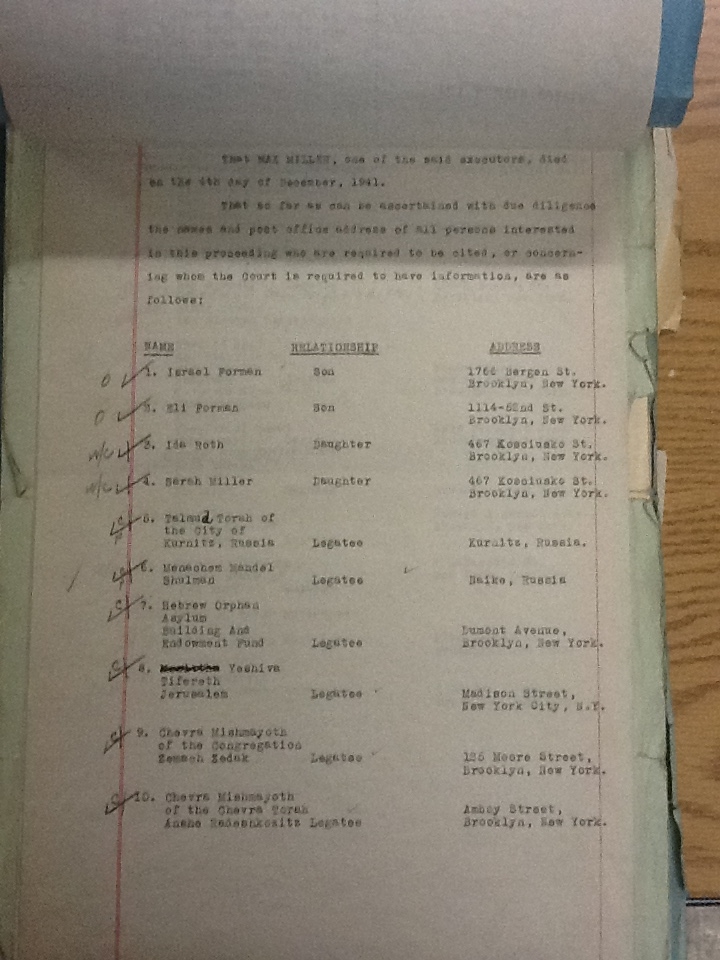
A !Eureka! moment: Sarah’s husband, Levi Selig Forman had died in 1935, also in New York and had left a detailed will.  In the will was a bequest to a “Talmud Torah of the city of Kurnitz.”Forman, Levi S last will amended p 1  Wow and double wow.  I had wondered ever since I first read his will, about why he chose to make a bequest to that city.

My grandmother had told me her parents had come from Vilyeyka.  Well, Kurnitz is a city in Vilyeyka. 

Reminder to self – if a date or place is entered into records as a result of a family story, always try to obtain the documentation no matter how much it seems like that might be overkill.


Posted in Uncategorized | Leave a comment

IAJGS Conference

What you might ask, is the IAJGS?  It’s the International Association of Jewish Genealogy Societies.  Once a year, the IAJGS in cooperation with the local Jewish Genealogy Society holds a conference.  This year, it’s in Salt Lake City, otherwise known as a genealogist’s research paradise.

This is day 2 of the conference and although there are lots of great sessions going on, I seem to go from informal conversation to informal conversation, meeting new people, finding and sharing resources and discovering new connections.  After all, this is what it’s all about, isn’t it?  Connections.

Posted in Uncategorized | Leave a comment

Salt Lake City research

The main Family History Library in Salt Lake City is like no other library I have ever been in.  It is definitely a paradise for genealogists.  Before you take your trip, you should try to organize and develop a plan.  Make a list of the people whose documents you will be searching for and get the FHL microfilm numbers.  Bring a USB drive with you.

I knew that most of what I wanted to find were records of people in New York City.  Although there were a few very specific people for whom I was searching, most of what I was looking for was documentation for people with a few very specific surnames.  I anticipated that there would be fewer than 100 records for each vital record category – birth, marriage & deaths.

The first thing I did was to go to the Steve Morse website stevemorse.org, choose vital records, and then open the search for birth records.  I put in the surname for which I was looking and when the search results came up, I copied the whole list and pasted it into a spreadsheet to which I could easily refer.

Now I had a working list of first and last names, dates, certificate numbers and microfilm numbers.  I could remove any records from this list that I knew I was not interested in.

The 2nd floor of the FHL had all the microfilms I needed.  There are huge banks of cabinets all clearly marked holding 10s of thousands (maybe 100s) of microfilms.  I pulled out the first 4 on my list and went to one of the microfilm readers (proscan) that had the ability to allow me to save to a usb drive or to print.  There is a 30 minute limit on these machines, but if there is no line, you can use them for longer periods.

Good luck with your research!

Posted in Uncategorized | Leave a comment

Foresnic Genealogy News: Social Security Death access

Many thanks to Dee Dee King for writing a terrific follow up article on the Social Security Death Master File (DMF) rulings, and sending me the link!  As she points out, the “article describes the certification and licensing process and the many limitations of the new DMF.”  Her article lays out the historical background and changes in accessing the Social Security Death Index (SSDI) and explains what the new rules mean for researchers.    http://www.forensicgenealogists.org/Resources.html Vol 4 #3 Special DMF Edition

Posted in laws affecting genealogical research | Leave a comment

Merging your family story with the story of the places they lived

For me, a genealogy dream come true is finding a cache of historical photos of an area in which the people I am researching lived.  This is invaluable in literally helping to visualize the place(s) they lived.  The more than 800,000 photos released earlier in the year by the New York City municipal archives is a treasure trove.  These photos come from all sorts of resources: the NYPD, the parks department, the mayor’s office, and many more agencies, as well as shots taken by WPA photographers during the Depression. There are maps and drawings, audio recordings and even mugshots from the DA’s office.

Take a nostalgic walk through history by visiting http://nycma.lunaimaging.com/luna/servlet  – be careful though – time will pass in the blink of an eye while you are perusing the pictures, and you can lose whole days!

Posted in Uncategorized | Leave a comment

Ever wonder…

…why your female ancestor born in the United States was not a U.S. citizen?  The reason goes back to a 1907 US law which removed a woman’s citizenship if she married a non-citizen!  This was part of the fall-out of fears of masses of immigrants coming to the US.  In 1922, two years after the passage of the 19th amendment  granting women the right to vote, the law was amended – now it allowed women to retain their US citizenship if they married a non-citizen who was eligible for citizenship.  In other words, someone who was not prohibited from becoming a citizen.  That law was later repealed, and a woman’s (or man’s) US citizenship is not revoked due to the citizenship status of their spouse.

Now comes the news: A resolution introduced by Senators Franken (D-MN) and Johnson (R-WI) on March 27 ( http://beta.congress.gov/113/bills/sres402/BILLS-113sres402is.pdf ) and currently before the Senate Judiciary Committee, apologizes for the 1907 Expatriation Act. To read more see the Los Angeles Times article at : http://tinyurl.com/l5hpt4t Original url: http://www.latimes.com/nation/la-na-apology-20140420,0,5493306.story#axzz2zSDuuEUl


Thank you, Jan Meisels Allen for bringing this to our attention.


Posted in Genealogy news | Leave a comment